Archbishop of Canterbury preaches on GI report
By Alex Singleton | 26 April 2005
 I am delighted to see that the Archbishop of Canterbury, Rowan Williams, has taken the time to read the GI's report, Trade Justice or Free Trade? and chose to discuss it in a sermon today at St Paul's Cathedral.
We have recently seen the publication of a very interesting report from the Globalisation Institute which is highly critical of the language of 'fair trade', arguing powerfully for free trade as the real engine of prosperity. There is a serious economic argument here - though it is worth mentioning that professional economists have expressed their scepticism about free trade as a mantra: it isn't only starry eyed religious activists. But surely the real issue is what the word 'free' means. Universal trade liberalisation may offer fresh markets and promise overall increases in wealth. It also forces choices on vulnerable countries, whose effects may be - in the short to medium term - very costly indeed to a whole generation of workers, to the environment, to political stability. As a number of economic surveys have made plain, you can have statistics that show a spectacular increase in national wealth alongside a reality of instability, increasing poverty in many areas and a loss of social cohesion. The Dutch development economist and politician Jan Pronk wrote recently that in the move to a liberalised economy, 'the losses are widely spread and cut deeply into the existence of people while the initial concrete benefits are concentrated in the hands of a new class'. His judgement is that in the long term 'free trade' promises greater benefits, but in the middle term its costs are immense unless there are clear mechanisms for compensation - unless the benefits are put to work for all. 'Freedom' in this context turns out to be a more complex matter than we might have thought.
I would like to make five points about his speech:
Firstly, I welcome his willingness to engage with both sides of the debate on trade. It is notable that he appears to accept the economic concept that trade is not simply about cutting up an existing pie differently, but about increasing the overall size of the pie.
Secondly, he was a lot more moderate than he could have been, and was presumably being sensitive to increasing concerns within the Church itself that a one-sided approach to trade justice is being put forward. He also, usefully, avoided the demonization of the term 'free trade' as practiced by some others.
Thirdly, he talks of the problems facing people when liberalization first happens. In the short term, of course, those who have to adapt may need help. But while transitions should be handled as smoothly as possible, the transition should not be used as an excuse for non-action. India's experience after independence shows that non-action on liberalization is totally opposed to the needs of the poorest. While protected companies benefited, the population as a whole got poorer, and many starved.
Fourthly, the Archbishop says: "As a number of economic surveys have made plain, you can have statistics that show a spectacular increase in national wealth alongside a reality of instability, increasing poverty in many areas and a loss of social cohesion."
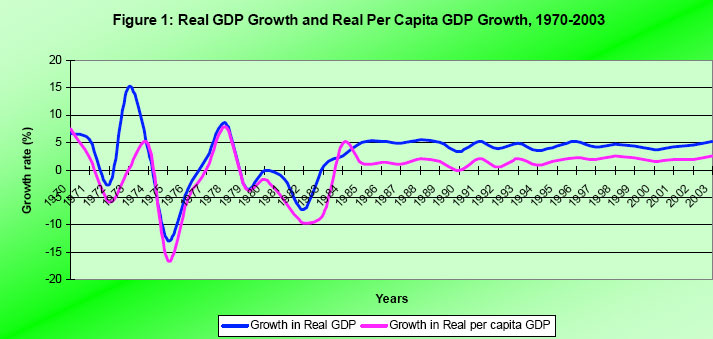
The sermon was given at a service celebrating 60 years of Christian Aid, and Christian Aid is keen to refer to Ghana, so I am going to take it as my example. The graph below (which you can see in full size by clicking on it) shows what has happened. When they were not following World Bank advice in favour of liberalization, their economy was massively unstable. But, since 1983, they have pursued liberalization. Guess what? Their real GDP has increased every year since 1983. Not even Britain has such a stable economic record. And poverty, though high, has decreased.
Fifthly, he says: "Does a nation, a society, work for all its citizens? If pressure for trade liberalisation creates a situation where this looks more remote, there is a clear problem from the Christian perspective."
The whole point about free trade is that it treats all sections of society equally. As Richard Cobden said: "the inalienable right of every man freely to exchange the result of his labour for the productions of other people, and maintaining the practice of protecting one part of the community at the expense of all other classes to be unsound and unjustifiable". The losers from globalization are specific interests who previously were able to force others to buy expensive products, while the winners are societies as a whole.
As the British government has pointed out, Ghana overall benefits from cheap imports of food because it enables people to eat more. Britain faced the same issue in the 19th Century. The population found food too expensive as a result of the Corn Laws which aimed to protect farmers from unfair foreign competition. Farmers complained that they would not be able to survive without protection. But the repeal of the Corn Laws was a great victory, and profoundly pro-poor.
In conclusion, I think the Archbishop's speech was an encouraging move for the Church of England. It is good that the debate has moved beyond slogans and it will be interesting to see how things progress in the coming months.