Thomas Friedman's Dell Theory echoes Richard Cobden
By Alex Singleton | 21 April 2005
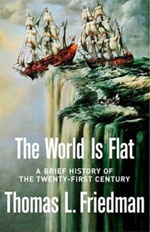 There's a fascinating article in today's Guardian. It's an extract from Thomas Friedman's new book, The World is Flat. It looks the manufacturing and logistics behind his order of his Dell laptop computer. It "involved about 400 companies in North America, Europe, and primarily Asia, but with 30 key players. Somehow, though, it all came together."
Like Richard Cobden, he recognizes the effect of trade on promoting peace. Cobden himself said that: "I see in the free trade principle that which will act on the moral world as the principle of gravitation in the universe - drawing men together, thrusting aside the antagonisms of race, and creeds and language, and uniting us in the bonds of eternal peace."
Friedman formulates the Dell Theory: "The Dell Theory stipulates: no two countries that are both part of a major global supply chain, such as Dell's, will ever fight a war against each other as long as they are both part of the same global supply chain, because people embedded in major global supply chains don't want to fight old-time wars any more."
The Dell Theory is an update of his previous Golden Arches Theory which "stipulated that when a country reached the level of economic development where it had a middle class big enough to support a network of McDonald's, it became a McDonald's country. And people in McDonald's countries didn't like to fight wars any more. They preferred to wait in line for burgers. While this was offered slightly tongue in cheek, the serious point I was trying to make was that as countries got woven into the fabric of global trade and rising living standards, which having a network of McDonald's franchises had come to symbolise, the cost of war for victor and vanquished became prohibitively high."