Democrats should remember Clinton
By Alex Singleton | 19 June 2005
 A recent leader in the Washington Post expresses disappointment at the lack of support for Central American Free Trade Agreement (CAFTA) among America's Democrats:
[CAFTA] promises important economic and foreign policy advantages. The fact that nearly all Democratic members of the House oppose this bargain - even the traditionally pro-trade New Democrats have come out in opposition - is a depressing sign of the party's abandonment of Clintonite centrism.
So is CAFTA a good deal economically?
A recent study by the University of Michigan estimates that U.S. income would rise by about $17 billion and Central American income by about $5 billion. World Bank economists have analyzed the deal and come up with positive conclusions.
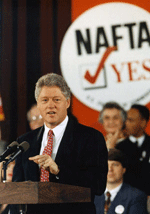
Instead of supporting special interests which are holding back the US economy, the Democrats should turn back to the example of Bill Clinton who was a strong defender of trade liberalization.
Back in the mid-1990s, Brad DeLong described why he was impressed by President Clinton's views on trade:
...being Governor of Arkansas for more than a decade had molded President Clinton's thinking about the importance of international trade for economic growth. In Governor Clinton's experience, the economy of Arkansas stagnated unless Arkansas companies could sell their products outside of Arkansas - and he spent a large chunk of his time as Governor promoting Arkansas companies and products, both to buyers in other states and to buyers abroad. He has generalized this more than decade of experience with the state to the nation. Thus ex-Governor Clinton feels in his bones the connection between exports in economic growth in a way that no ex-Senator does.[I noticed] the high demonstrated priority that President Clinton has given to trade - both trade liberalization measures, and also export expansion measures - in his administration. I heard domestic advisors warn that making NAFTA a high priority in the fall of 1993 would push health care into 1994, and give opponents an extra year to organize against health care reform; yet he made NAFTA his highest priority in the fall of 1993. I heard strategists warn that pushing for GATT approval in the fall of 1994 might weaken his political base among the non-pro-free-trade elements of the Democratic coalition; he made GATT approval a high priority in the fall of 1994.
In early 1995 - when the administration was working to contain the Mexican peso crisis, and to stop it from becoming a general liquidity crisis affecting many industrializing economies - administration opposition to a badly-drafted balanced-budget amendment was moderated if it threatened to endanger bipartisan cooperation on international finance.
President Clinton has a proven, tested, visible record of being willing to take major political risks in order to do what he thinks is right for the country as far as international economic policy is concerned. And what he thinks is right for the country is lowering barriers to international trade and expanding U.S. access to export markets.
Democrats should follow the Clinton path and give their support to CAFTA.