


E-mail list
Keep up-to-date with the work of the GI with our e-mail bulletin every few weeks.
Six of the best
CIPE Development BlogJohan Norberg
Philippe Legrain
Pienso
World Bank PSD
Trade Diversion
Blogroll
About Globalization
Adam Smith Institute
Atlantic Blog
Brian Micklethwait
Business & Economics
Cafe Hayek
Capital Spectator
Catallaxy
Center for Global Development
Chippla's weblog
Civitas Blog
Club for Growth
ConservativeHome
Daniel W. Drezner
David Smith
De Gustibus
EconLog
Franck's blog
Freedom Institute (Ireland)
From the Heartland
Gavin Sheridan
Global Growth Blog
Hillary Johnson
Hit and Run
Iain Dale
IndiaUncut
Institutional Economics
Knowledge Problem
Kurt Johnson
Market Center Blog
Mises Institute
Mutualist Blog
Natalie Solent
ODI
Owen Barder
Pharmopoly
Positive Externality
Private Sector Development
Radley Balko
Right to Create
Rip Mix Burn
Samizdata.net
Sobering thoughts
Social Affairs Unit
Spontaneous Order
TechDirt
The American Mind
The Commons Blog
The Liberal Order
The Welfare State We're In
Tim Worstall
Tom G. Palmer
Trade Diversion
Unrestricted Domain
Vaccines for Development
| BlackBerry, infant industries and the global spread of ideas |

|

|

|
| Monday, 04 April 2005 | |
|
One of the benefits of globalization is that ideas are able to freely spread and compete. Back in the mid-1990s, the Psion pocket computer was a popular device. It kept a calendar and had a simple word processor and spreadsheet. Psion (a British company) invented the pocket computer, but it wasn't long until overseas competitors joined the market, most notably Palm in the United States. Palm worked out that Psion's clam-shell devices with big keyboards were larger than people wanted to carry. They used a stylus and handwriting recognition instead. Over time, different companies - in different nations - have worked out how to improve such devices. When travel writer Mark Moxon was on a long trip in the mid-90s, he carried around a pocket computer with a separate modem and an acoustic coupler which he used to send e-mail through payphones. Gradually people started using cellphones to send e-mail, connected by cable to a laptop or pocket computer. Then Bluetooth got rid of the cable, making the connection wirelessly. Three or four years ago I upgraded my mobile phone to a Sony J7 - Sony, of course, being Japanese. The phone could collect e-mail on its own. But it was so slow and cumbersome to do this that the feature was used only in emergency. It would have to dial up the internet and then only let you access your e-mail very, very slowly. But it was a good step. Phones and pocket computers have gradually merged. In the UK, the most notable example is the XDA sold by mobile network o2. It is made by HTC, a Taiwanese firm.
The Economist described the BlackBerry in this way: What Apple's iPod music-player is to teenagers, the BlackBerry e-mail hand-held is to executives: the gizmo they cannot be seen without, and often cannot live without. But you probably knew that already: readers of The Economist are smack in the middle of the BlackBerry demographic. At conferences, in boardrooms and on commuter planes and trains, they are everywhere. It's thanks to international trade that I can benefit from my BlackBerry. It's not just that it's made by a Canadian company. I benefit because lots of different companies around the world are competing. By copying and licensing ideas from each other, there is a race to the top. Psion, the British producer, kept on building bigger and bigger devices, and consumers rejected them. Only because consumers were free to buy according to cost and quality that we get to use devices as good as the BlackBerry and others today. The race to the top is why it is so vital that developing countries open up their markets. The Trade Justice Movement think that protectionism will help poor countries by enabling them to grow infant industries. It sounds good in theory, but in reality protectionism creates sickly, bloated companies that are unable to compete in world markets when markets are finally opened. As Philippe Legrain wrote in his book Open World: The Truth about Globalisation: India's experiment in industrialisation along national lines bred 'national champions' that actually championed their own interests at the expense of ordinary Indians. Big companies fleeced consumers, selling shoddy goods for inflated prices. Rather than investing their profits in better technology, they chose to lobby for more special favours from government... The state poured vast sums into white elephants. The fact cats lived the life of riley; the poor, often literally, starved. Indian companies did not invest enough. Nor, without the spur of foreign competition or signals from world prices to guide them, did they invest wisely. The economy stagnated. India's already miserable living standards actually fell in the 1960s and 1970s. The tragedy of the Trade Justice Movement is that the protectism it supports is impoverishing the very people it is trying to help. Poor people don't need this warped version of trade justice - they need free trade. |
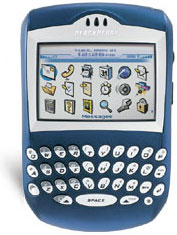 But it was a Canadian firm that sorted out how to do mobile e-mail. They realised that people didn't want to have to dial up to collect their e-mail. They wanted the e-mail to be 'pushed' to their phones automatically. That firm,