


E-mail list
Keep up-to-date with the work of the GI with our e-mail bulletin every few weeks.
Six of the best
CIPE Development BlogJohan Norberg
Philippe Legrain
Pienso
World Bank PSD
Trade Diversion
Blogroll
About Globalization
Adam Smith Institute
Atlantic Blog
Brian Micklethwait
Business & Economics
Cafe Hayek
Capital Spectator
Catallaxy
Center for Global Development
Chippla's weblog
Civitas Blog
Club for Growth
ConservativeHome
Daniel W. Drezner
David Smith
De Gustibus
EconLog
Franck's blog
Freedom Institute (Ireland)
From the Heartland
Gavin Sheridan
Global Growth Blog
Hillary Johnson
Hit and Run
Iain Dale
IndiaUncut
Institutional Economics
Knowledge Problem
Kurt Johnson
Market Center Blog
Mises Institute
Mutualist Blog
Natalie Solent
ODI
Owen Barder
Pharmopoly
Positive Externality
Private Sector Development
Radley Balko
Right to Create
Rip Mix Burn
Samizdata.net
Sobering thoughts
Social Affairs Unit
Spontaneous Order
TechDirt
The American Mind
The Commons Blog
The Liberal Order
The Welfare State We're In
Tim Worstall
Tom G. Palmer
Trade Diversion
Unrestricted Domain
Vaccines for Development
| Globalization and the environment |

|

|

|
| Monday, 04 April 2005 | |
|
The wetlands, forests, savannahs, estuaries, coastal fisheries and other habitats that recycle air, water and nutrients for all living creatures are being irretrievably damaged. In effect, one species is now a hazard to the other 10 million or so on the planet, and to itself. But it perhaps did not go far enough. All of the problems found by the report are to do with the old chestnut, the Tragedy of the Commons. When there is open access to a resource, and pressure on that resource is growing, then access must be limited. As the report goes on to point out (starting at page 154) we know, in general, how to do this. One (not the only, but one) method of doing this is to assign private ownership of the resource in question, and then promote a market in its use, so that ownership passes to those who value it highest, and that is certainly what I think they are suggesting in these two policy recommendations: ...[a] wide range of opportunities exists to influence human behavior to address this challenge in the form of economic and financial instruments. Some of them establish markets; others work through the monetary and financial interests of the targeted social actors; still others affect relative prices. Specific examples mentioned are individual transferable quotas for fisheries (along with no fish zones) and private ownership of wildlife like the big game animals of Africa. There are also four scenarios developed to save these ecosystems, one of which is: More specifically, in Global Orchestration trade barriers are eliminated, distorting subsidies are removed, and a major emphasis is placed on eliminating poverty and hunger. In short, globalization in order to save the planet. A good week for Alex to move to the Institute full time I think. |
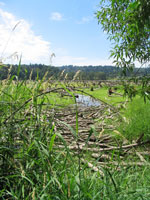 The Millennium Ecosystem Assessment was released last week and was, to my mind, sadly under-reported. You can get a copy here if you wish to read all 256 pages.